
Texas Senate Transportation Committee hears testimony on rail-xing funding windfall; Chairman Parker asks for ideas
August 25, 2026 - TRA Austin -
Fresh from an announcement August 14th that the state will receive three quarters of a billion dollars in federal rail crossing funds, Texas Senate Transportation Chairman Tan Parker asked those giving testimony at a hearing in Austin today for ideas on what else can be done to keep road/rail crossings safer and traffic moving.
Some of the ideas that came out of the hearing included moving rail sidings further away from busy rail crossings, finding ways to alleviate blocked rail crossings and eliminate seldom-used crossings while working with communities to find alternate routes. Also discussed was use of technology to alert motorists on their apps, such as Google and Waze, about trains that occupy crossings so you may look for an alternate route to your destination.
Rail Division Director Don Franks reported how the Texas Department of Transportation used $250 million the legislature appropriated in 2025 for at-grade rail crossing projects, parlaying a $77 million portion of the state funds into federal grants announced last week that will bring $755 million dollars to create overpasses at congested and dangerous rail crossings.
To qualify for federal grants in this specific program, projects had to be on one of the freight rail lines in Texas that are used by Amtrak for passenger service. Amtrak does not own any rail infrastructure in the state. There are two other federal programs that have matching funds available for grade separations, not restricted to passenger rail, and those recipients are yet to be announced. Several projects have been filed under those programs.
"Senate Bill 1555 created an important opportunity for Texas. TxDOT had the groundwork in place, moved quickly to implement the law, made the first awards and leveraged state investment into a broader federal partnership," according to the head of the rail division. "The demand remains significant. The program has already moved Texas farther toward safer crossings, stronger mobility, and better support for local communities in the rail network."
The first call of requests from across the state resulted in 58 projects asking for $2.5 billion dollars, ten times the funding available.
 Franks said he is still awaiting details from the Federal Railroad Administration, following the announcement 11 days ago, on the exact amount of each award. "We have the bundle amounts, we know how much the total we can spend up to, we are still waiting for the details of each amount of match funds to each project," according to Franks. "There will be some money left over and anticipate possibly awarding another project when all of the dust settles."
Transportation Committee Chairman Parker asked the rail division director "how would you achieve success five years from now and what are some of the metrics that you recommend we look at?" Franks responded that once the Transportation Commission awards the projects to contractors, his goal is to push toward having them under construction and delivered within three years.
French Thompson of BNSF spoke for the Texas Railroad Association, that represents the three major railroads as well as regional and short line railroads in the state. "So where should the program go from here?", asked Thompson. "In the view of the TRA (railroad association) the answer is to keep the momentum going. The program works, the demand is proven and the state's dollars are being matched. Our recommendation is that the legislature maintain the investment of the 250 million dollars next session. That level of commitment is what keeps Texas competitive for opportunities ahead of us."
Texas Rail Advocates President Peter LeCody testified before the committee and said "because of SB 1555, for the first time ever, Texas can participate in competitive federal rail crossing grant programs. TxDOT now has the tools and the feds have the funds so this deserves continued state investment so we can capture matching federal funds. Let's keep it going."
LeCody mentioned that in the past, TxDOT was not able to participate in matching fund programs. On the Texas Rail Advocates website he said it's documented that, in the last decade, the state lost out on over a billion dollars in matching federal funds. "We have the program now so let's take advantage of this and use it wisely."
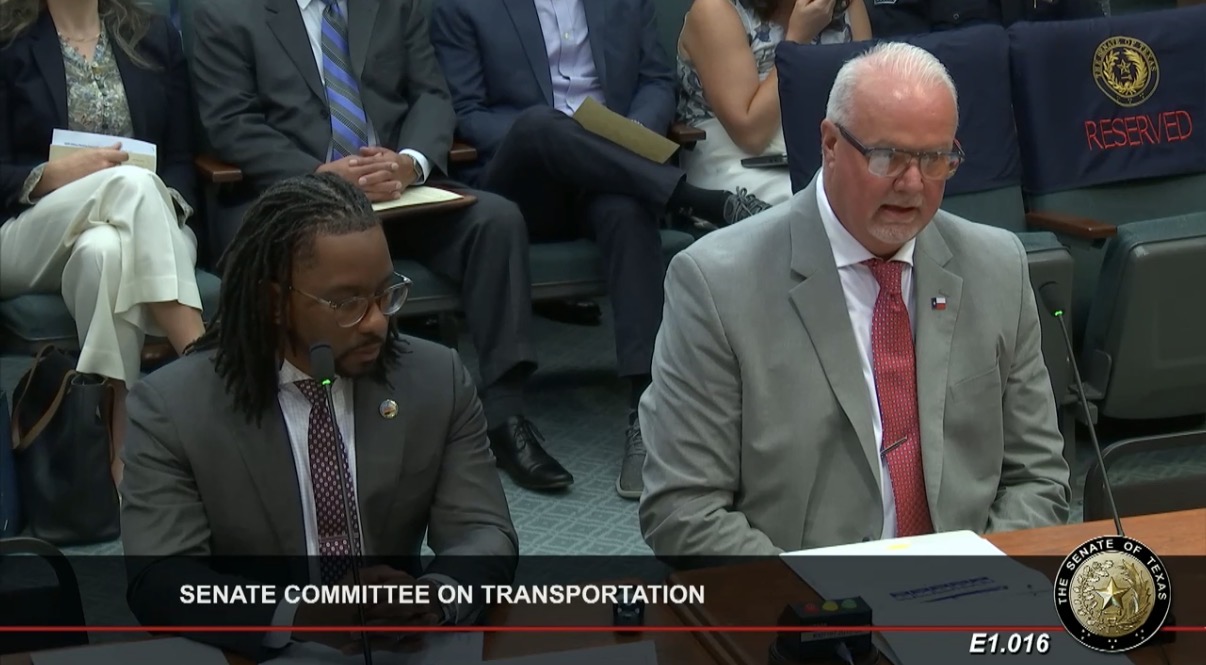
Pictured: French Thompson of BNSF, representing Texas Railroad Association; Don Franks, TxDOT on right